Porto (via Môre)
Tag Porto: the real design is in the alternative flows
Porto's toll and parking tag, built with ConectCar, had become a funnel for the credit card. Designing the main flow was easy. The work was giving every exit from it a decent path.
- Role
- Senior Product Designer, Bens squad
- Period
- 2023
- Sector
- Insurance and financial services
Pain points
- The goal was to sell the card, and the tag flow became a card funnel. People wanted a tag, not a card.
- An old rule only allowed the card for auto insurance customers: almost nobody was eligible.
- For people who were not eligible, the flow simply stopped.
- In the reverse flow, the card could offer a tag to someone who already had one.
Discovery
- 01Profile mapCardholder, pre-approved and not eligible, each with its own exit.
- 02FlowchartEvery order and activation path in one map, including the exits from the main flow.
- 03Data sourceWith no API to know who had a tag, the answer came from the factory that produces and ships them.
Journey
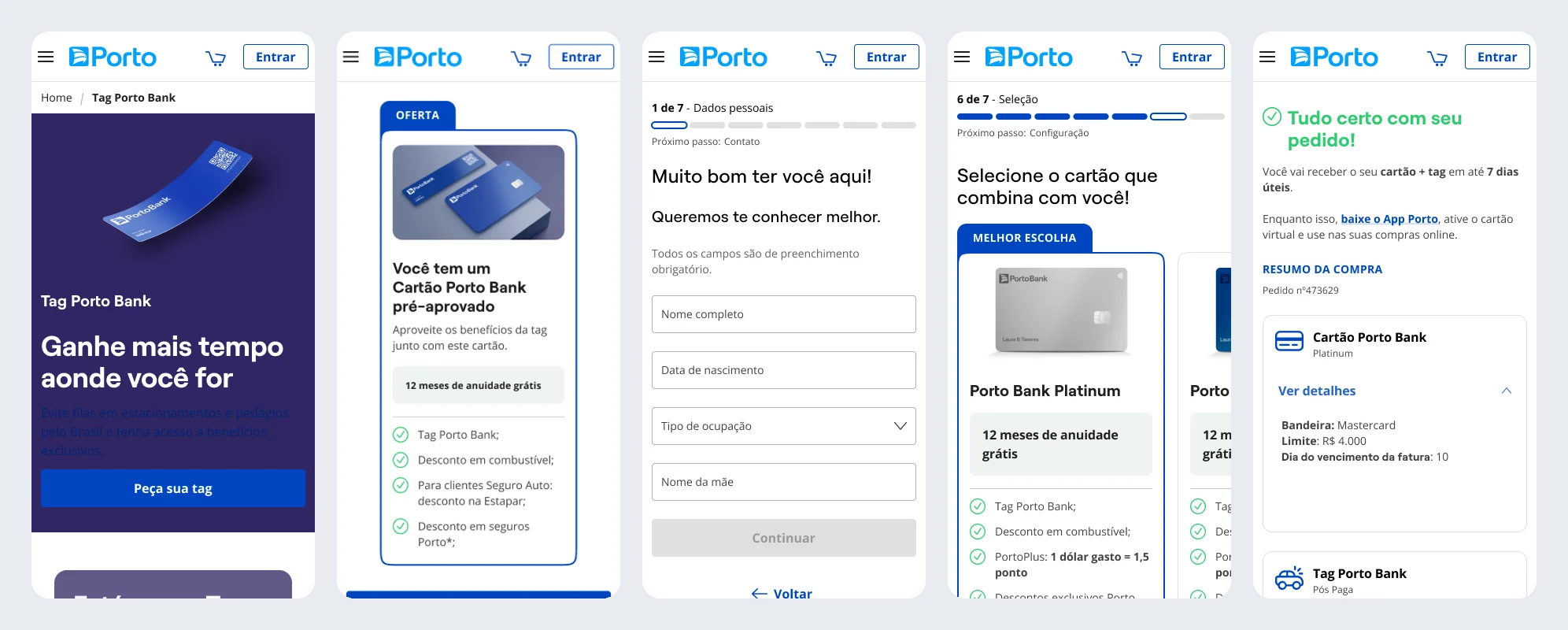
- 01Tag pageBenefits and the Order your tag button.
- 02CPF checkPicks the right path for each profile.
- 03OfferTag with a pre-approved card and 12 months with no annual fee.
- 04FormSeven steps, from sign-up to card setup.
- 05ConfirmationOrder summary and virtual card activation in the app.
- 06ActivationBy mail or pick-up, completed in the Porto app.
What changed
- Not eligible got a path: a prepaid ConectCar tag, with Porto's identity.
- The card rules were relaxed and the funnel stopped being fiction.
- Existing tag owners stopped getting repeated offers.
- LGPD consent component with opt-in and opt-out.
Context
At Porto, I was the point person for the Sales Hub checkout, the ecosystem that brought together more than 80 products and services that used to live in separate flows. Every product team had to adapt to the rules we set to join the hub.
Tag Porto, the toll and parking tag built in partnership with ConectCar, was my responsibility.
The problem
The business goal was to sell the Porto credit card. So much so that the tag's main flow became a card funnel: eligible customers got the tag together with the card. It felt forced to me. People wanted a tag, not a card.
But the real problem started when the main flow failed, and it failed almost every time. An old rule only allowed the card for people who already had auto insurance, so almost nobody was eligible. For everyone else, the flow simply stopped: an interested customer, left empty-handed.
There was also the mirror case, in the reverse flow: cardholders could add a tag when signing up, without us knowing who already had one. The risk was offering a tag to someone who already owned it.
The decisions
Not eligible? Nobody leaves empty-handed. The ConectCar partnership allowed something better than a "you can't": sending the customer, without friction, to a ConectCar page with Porto's visual identity, where they could buy a prepaid tag with no credit card needed. The exit became a path, not a closed door.
Eligibility impossible? Change the rule instead of accepting a fictional funnel. We pushed leadership to relax the card rules: if almost nobody got through, the whole funnel was fiction. The rules were relaxed.
Already a customer? Know before offering. To find out who already had a tag, the default answer was "there's no API". I proposed asking whoever certainly knew: the factory that produces and ships the tags to customers. After a lot of discussion, the bridge was approved, and it worked.
Ordering and activation
From the same product page, ordering follows three paths: cardholder, eligible for the card and not eligible. Eligible customers see the card offer with the tag and go through a seven-step form, from personal details to card setup, always showing where they are and what comes next.
Activation starts by identifying how the tag arrived, by mail or pick-up, and checks the CPF. Cardholders, pre-approved customers and unknown CPFs each have their own exit, including activation inside the Porto app. Privacy consent (LGPD) got its own opt-in and opt-out component.
Result
Every alternative ending of the flow got a designed answer: people who were not eligible got the prepaid path, eligibility stopped being fiction and existing tag owners stopped getting repeated offers. None of the solutions needed new technology. All of them needed someone to refuse "it can't be done".
The lesson that stayed: the main flow is the easy half of the design. Real product work is what happens when things do not go as planned.
Want something similar?
Describe the problem. alema.io replies with a path, not a generic quote.